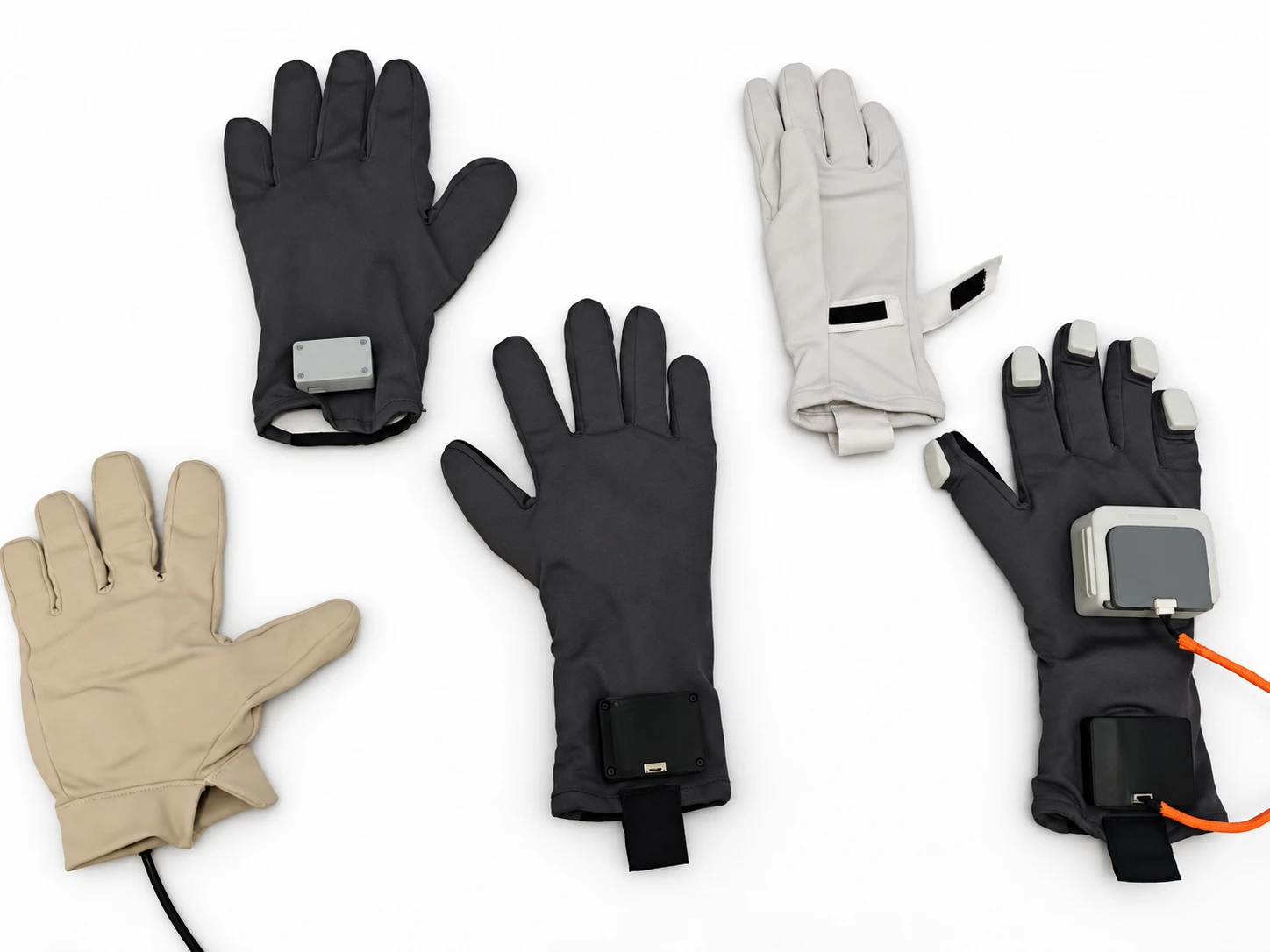
It records not just how the hand moves, but when and where contact happens. A palm-side tactile array combined with electromagnetic fingertip poses provides multimodal research input for dexterous manipulation, teleoperation mapping and visuo-tactile fusion.
A fabric piezoresistive array covers the main palm-side contact areas, with 360 points standard and 600 optional. Raw ADC values and point mapping are recorded; converting to force or pressure requires independent calibration.
02
Reconstruct hand pose from fingertip poses
Five electromagnetic sensors provide 6-DoF tracking of each fingertip, and an algorithm reconstructs a 25-DoF hand pose. The reconstruction is not 25 independently measured joints, nor ground-truth robot actions.
03
Connect to multimodal research
Data is accessed over USB with a licensed SDK; wireless is optional. In joint experiments with Ego, UMI or robots, calibration, cross-device timing and end-effector mapping must be validated separately.
TWO STREAMS. ONE EXPERIMENT.
Where the hand is, and where it touches.
Touch and pose are recorded separately and, after calibration and time alignment, become traceable research data.
01 / CONTACT
360-point tactile sensing
200 Hz standard · rated
Palm 240Fingers 120ADC
Preserves contact location and relative change. Single-point raw readings can only be interpreted as physical quantities under agreed conditions after dedicated calibration.
Electromagnetic tracking captures fingertip poses, from which an algorithm reconstructs a 25-DoF hand pose. Observations, reconstruction and robot action mapping are stored in separate layers.
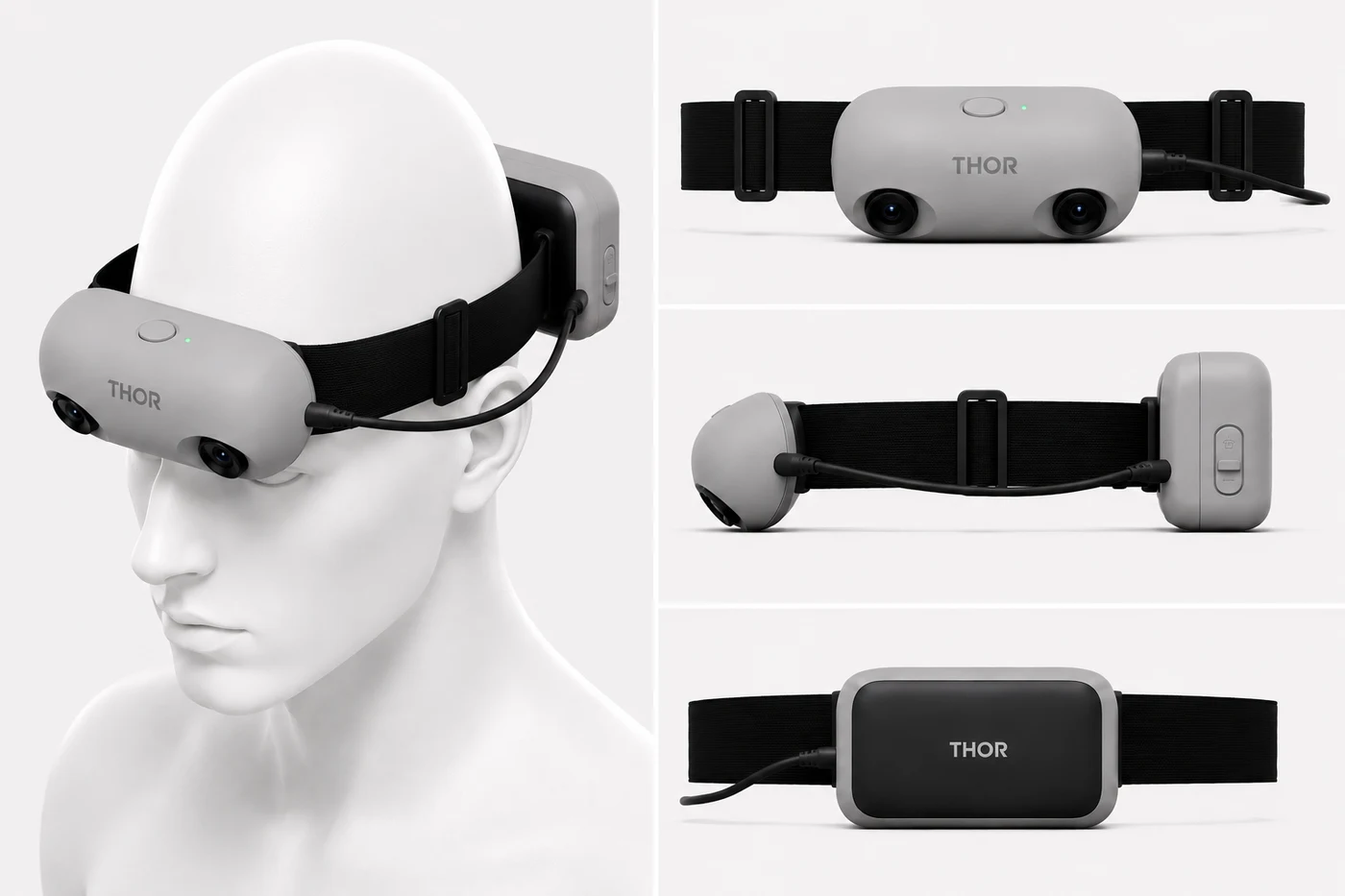
Joint capture plan: touch + pose + Ego video + task events. The two streams run at different sampling rates; cross-device hardware sync and robot adaptation are not built in and need project validation.
THE DETAILS MATTER
Every detail, spelled out.
Palm tactile array and fingertip electromagnetic tracking for dexterous manipulation and teleoperation research.
Standard, optional and upgrades
Item
Standard
Optional / future
Tactile points
360 points
600 points optional; point layout confirmed separately
Tactile sampling
200 Hz
400 Hz is a future upgrade path, not a current delivery commitment
Connection
Wired USB
Optional Bluetooth / wireless, requires receiver and battery module
Power
USB
Optional battery module; capacity and battery life confirmed per setup
Appearance
Confirmed by style and hand
Color, outer material and protection customizable
Base package
1 glove + 1 data cable
Two-hand sets and tracking equipment listed separately
The number of gloves shown is not the standard set. Inclusion of the electromagnetic field generator / reference source, receiver, SDK license and related accessories must be confirmed separately.
Tactile array and measurement metrics
Parameter
Spec / configuration
Sensing principle
Flexible fabric piezoresistive tactile array
Standard point layout
24 points per finger (16 fingertip + 8 mid-finger); palm 16 × 15 = 240 points; 360 points in total
Coverage
Main palm-side areas, excluding the base of the four fingers; final coverage per the point-mapping table
Point density
Rated 9 points/cm²
Single-point trigger / max range
20 g / 1500 g
Standard sampling rate
200 Hz
Raw output
Per-point ADC values / total ADC; not directly N or Pa
Repeatability / consistency
Both ±15% FS (full scale), not ±15% of the current reading
Contact area, pre-stretch, fit tightness and ambient temperature and humidity all affect readings. Across people, days or re-wearing, record a baseline and validate calibration.
Electromagnetic tracking and pose reconstruction
Parameter
Spec / configuration
Sensors
5 electromagnetic tracking sensors, each providing 6-DoF tracking
Tracking output
3-axis position + 3-axis rotation per fingertip; rated 180 Hz
Hand reconstruction
Algorithm-reconstructed 25-DoF pose, not 25 independently measured joints
0.2 mm figure
Tracking accuracy 0.2 mm / resolution <0.2 mm
Data latency
Table rates 10 ms wired / 30 ms wireless, and the text says below these values; actual latency must be stated with measurement endpoints and test conditions
Deployment and integration
Tracking volume, reference frame, field generator specs and metal-interference conditions
Documented tracking figures are not treated as measured accuracy, and sensor link latency is not robot end-to-end control latency. Different sampling rates do not mean the two streams are hardware-synchronized.
Power, environment and reliability
Parameter
Spec / configuration
Battery
1200 mAh
Battery life / charging
Rated 2.5 hours / 2 hours; load and test conditions not stated
Operating temperature
-15 °C to 60 °C, rated
Operating humidity
0–90% RH
Reliability
>500,000 impacts at 10 kg (rated)
Protection and cleaning
No water-resistance claim for the electronics; avoid liquids, sharp objects and pulling on cables; clean with a soft dry cloth
Communication, SDK and data integration
Parameter
Spec / configuration
Wired interface
USB communication; custom PID confirmed per project
Wireless interface
Optional Bluetooth / wireless receiver and battery module; protocol version and compatibility to be confirmed
SDK
Documentation provides Windows / macOS / Linux SDK licenses; license scope per agreement, not open source
Custom development
Data frame protocol, point-mapping table and development versions provided as agreed
Tactile data
Per-point ADC / total ADC, tied to hand, point table and calibration version
Pose data
Position and rotation of each fingertip; reconstructed pose and algorithm version stored separately
Recommended archive
Raw frames, device version, hand, anonymous participant ID, wearing baseline, task events, timestamps and clock mapping
Platform adaptation
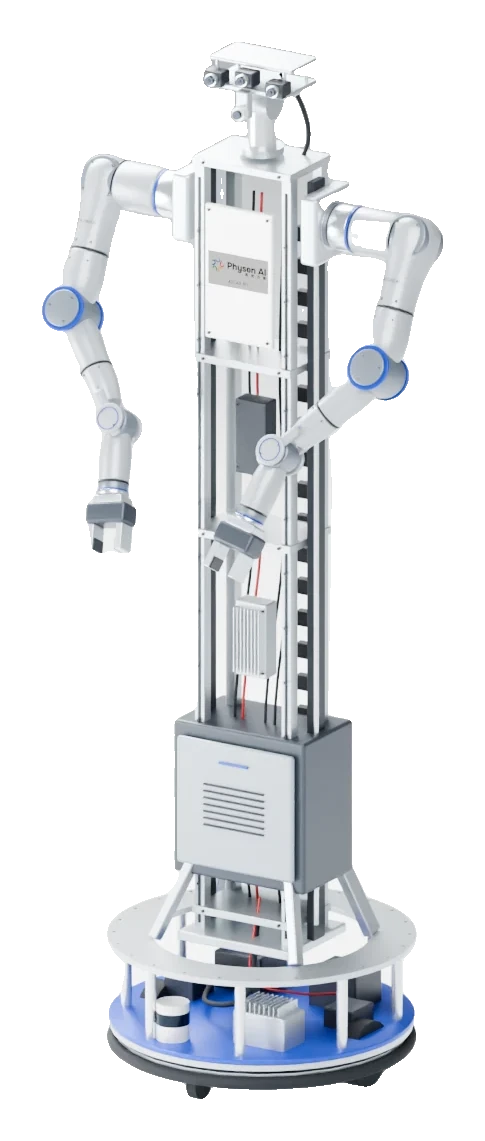
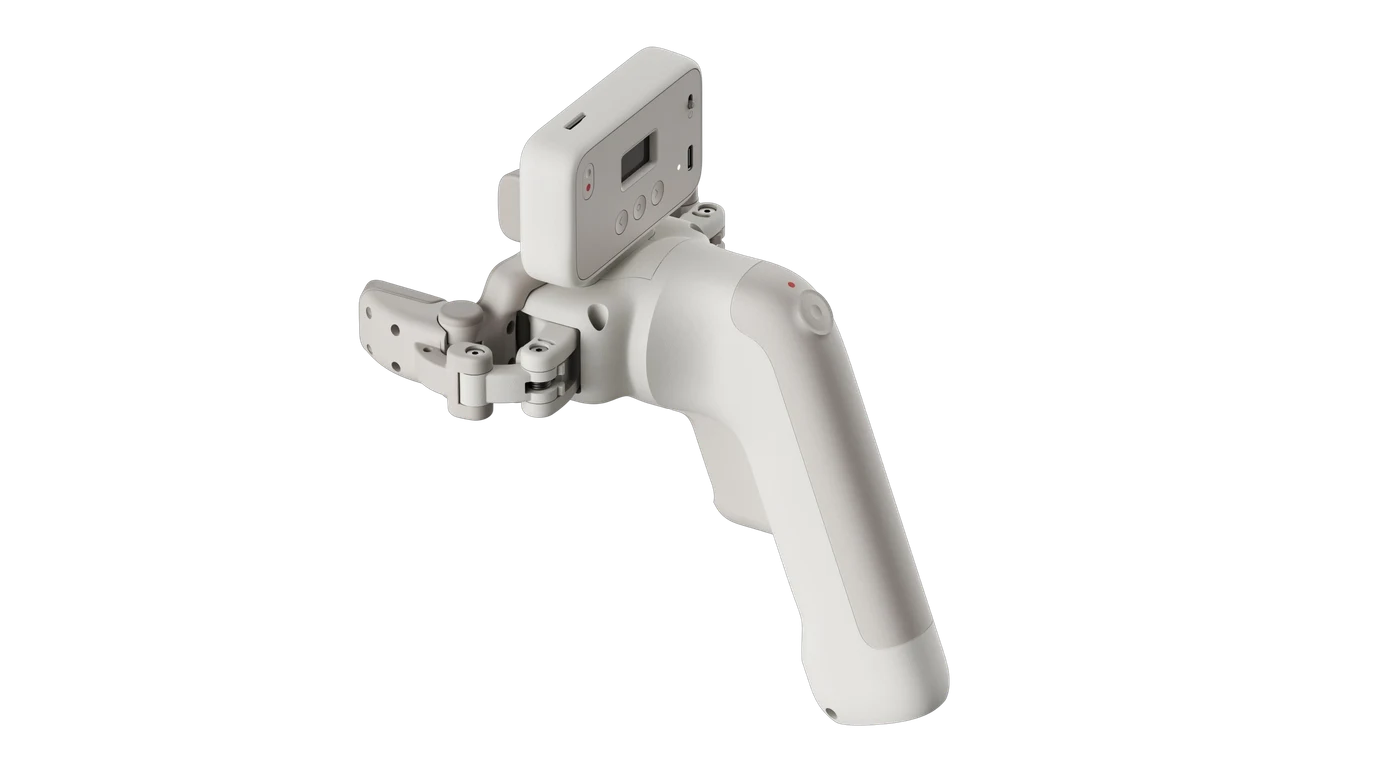
Pairing planned with the Ego Thor series, UMI, Atlas and FMG + IMU; export format and cross-device sync error need project validation
Raw ADC, calibrated force values, estimated hand pose and mapped robot actions should be stored separately. Data alignment and platform adaptation are part of the integration scope, not a default promise of current device capability.
FROM CAPTURE TO ARCHIVE
From power-on to a complete data episode.
01
Confirm configuration and fit
Check left/right hand, tactile points, tracking equipment and connection; inspect cables and contact areas.
02
Set baseline and coordinates
After putting it on, record the pre-stretch baseline, confirm the electromagnetic reference source, coordinate frame and metal-interference conditions, and complete the calibration the task needs.
03
Check both data streams
Check the actual rate, dropped frames and latency of the 200 Hz tactile and 180 Hz pose outputs separately, saving raw data and versions.
04
Joint capture and archiving
Link to vision or real-robot data, validate time mapping, then generate contact events, reconstructed poses and training data, keeping all processing records.
CONFIGURE. VERIFY. DELIVER.
From selection to delivery, make the configuration clear.
Freeze 360 / 600 points, left/right quantities, connection method and appearance version; check the standard package per single glove.
Confirm the electromagnetic field generator, tracking volume, metal-environment limits, and the battery, wireless receiver and SDK license list.
Validate tactile repeatability under agreed loading area and calibration conditions, and clarify how the 0.2 mm and latency figures are measured.
After confirming the frame protocol and point mapping, complete decoding tests and accept tactile, pose, cross-device alignment and robot mapping separately.
Compare results with and without tactile or pose data on fixed tasks and the same training budget; no automatic improvement in robot success rate is promised.