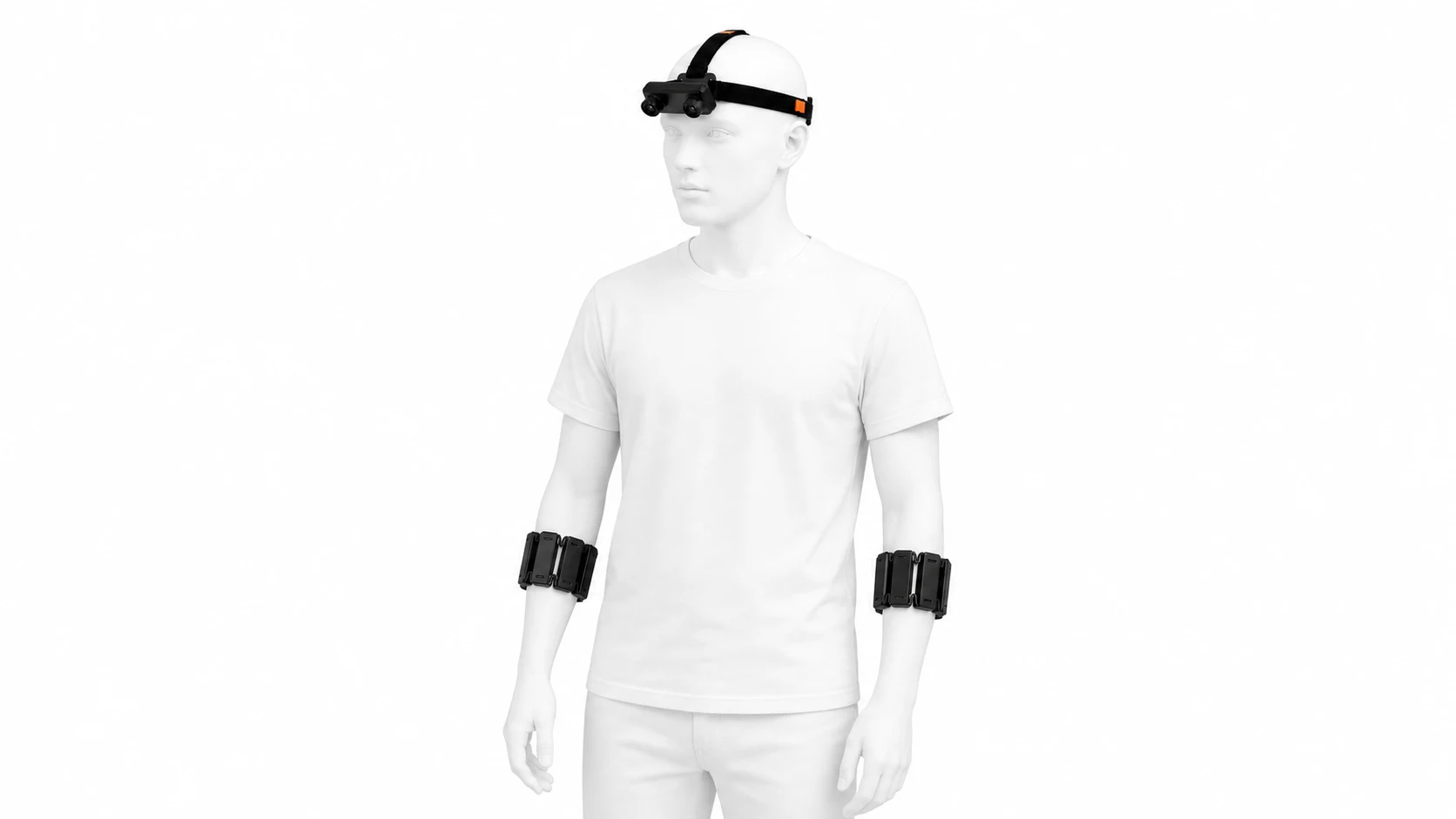
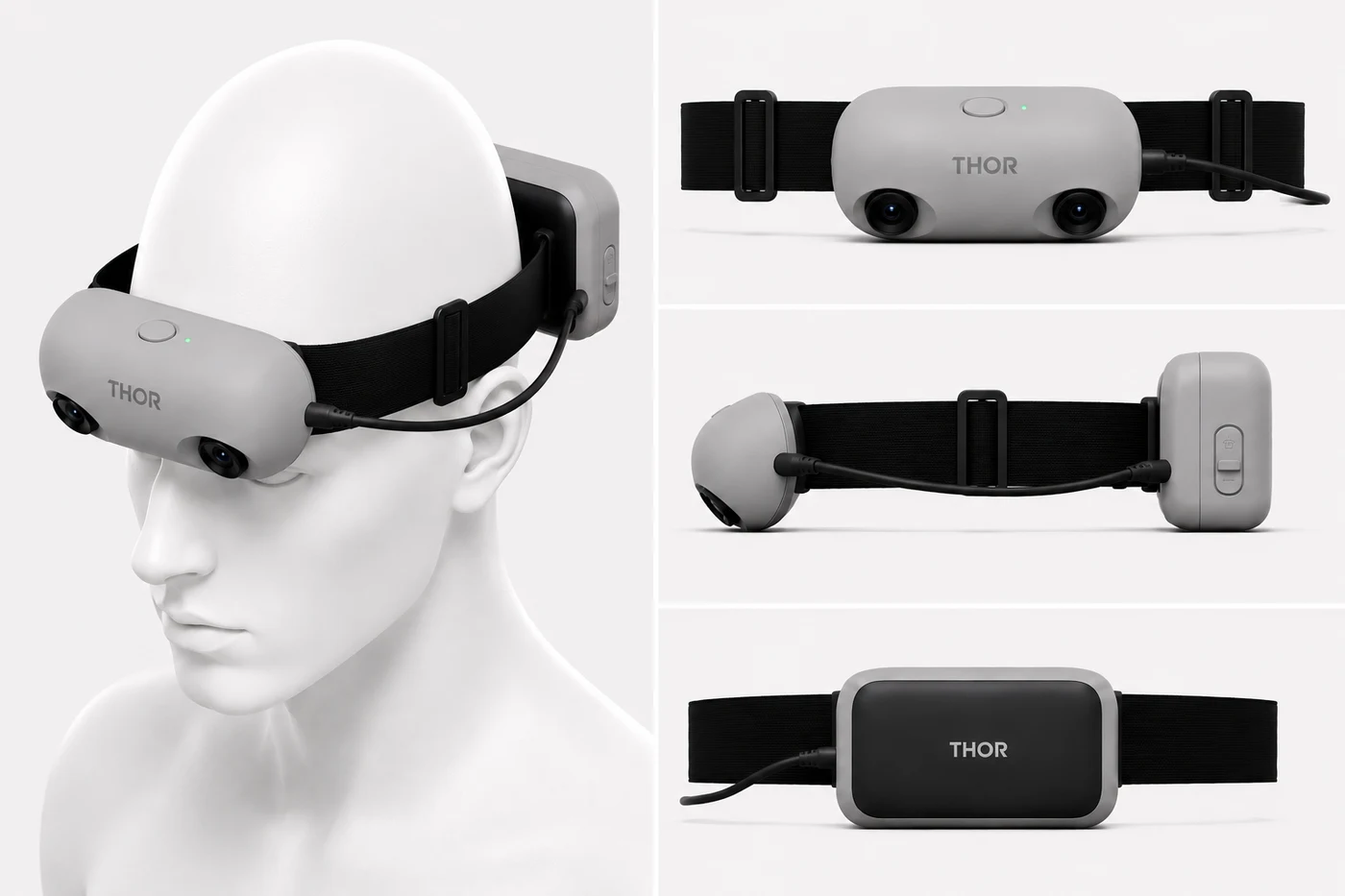
FMG arrays and an IMU sit on the forearm, pairing muscle-deformation-related contact pressure changes and inertial motion with egocentric video. With a head-mounted stereo camera plus armbands on both forearms, the hands stay free for natural contact, producing research data for gestures, hand pose and robot learning.
Armbands on both forearms can work with head-mounted vision without covering the palms or fingertips. This is a capture approach for natural manipulation demonstrations; "glove-free" does not mean it replaces every tactile or hand-pose device.
02
A module array that records motion cues
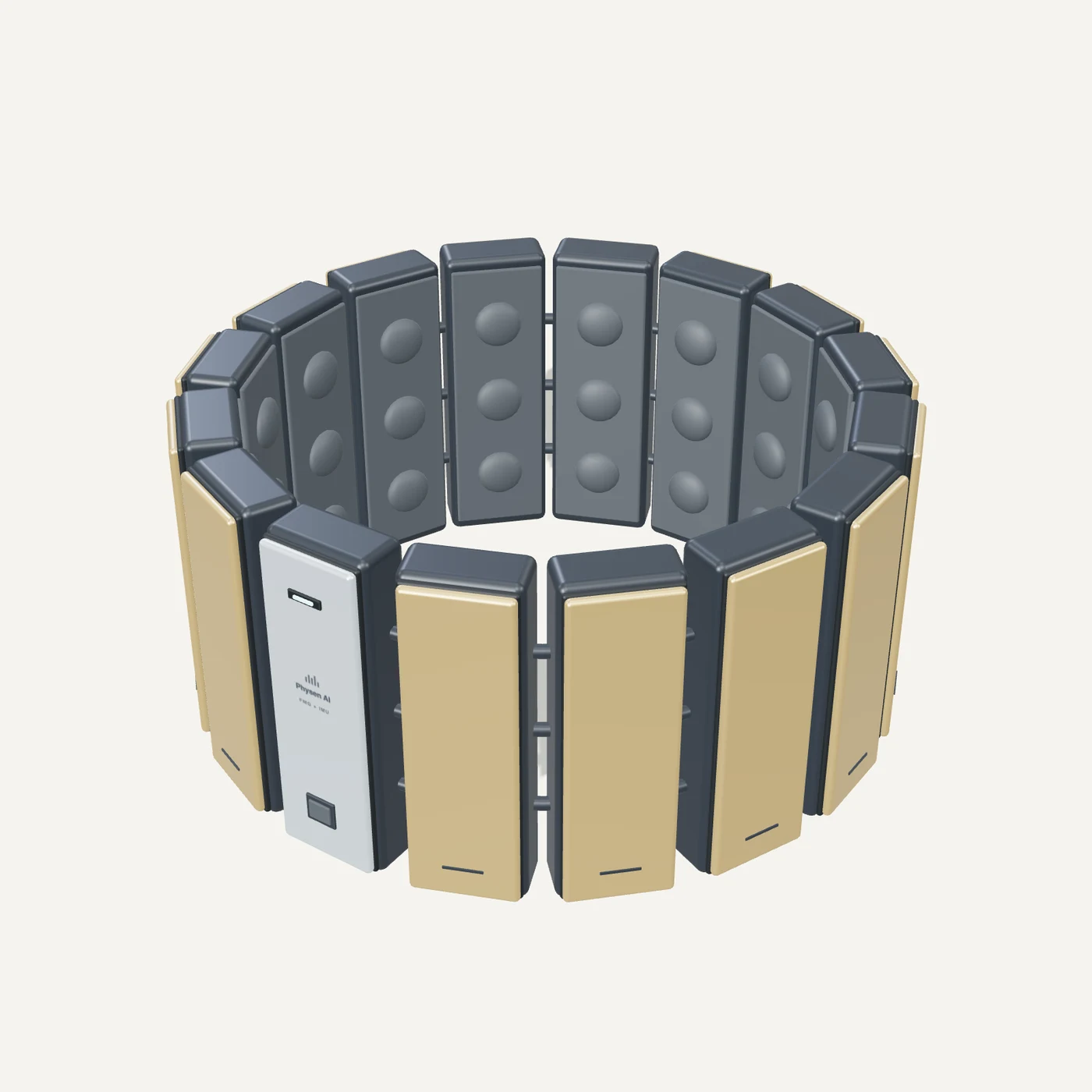
The video shows a modular ring structure, inner contact units and an IMU. FMG deformation signals complement vision; forearm contact changes detected by the sensing units are not contact forces between fingers and objects.
03
From demonstration capture to model research
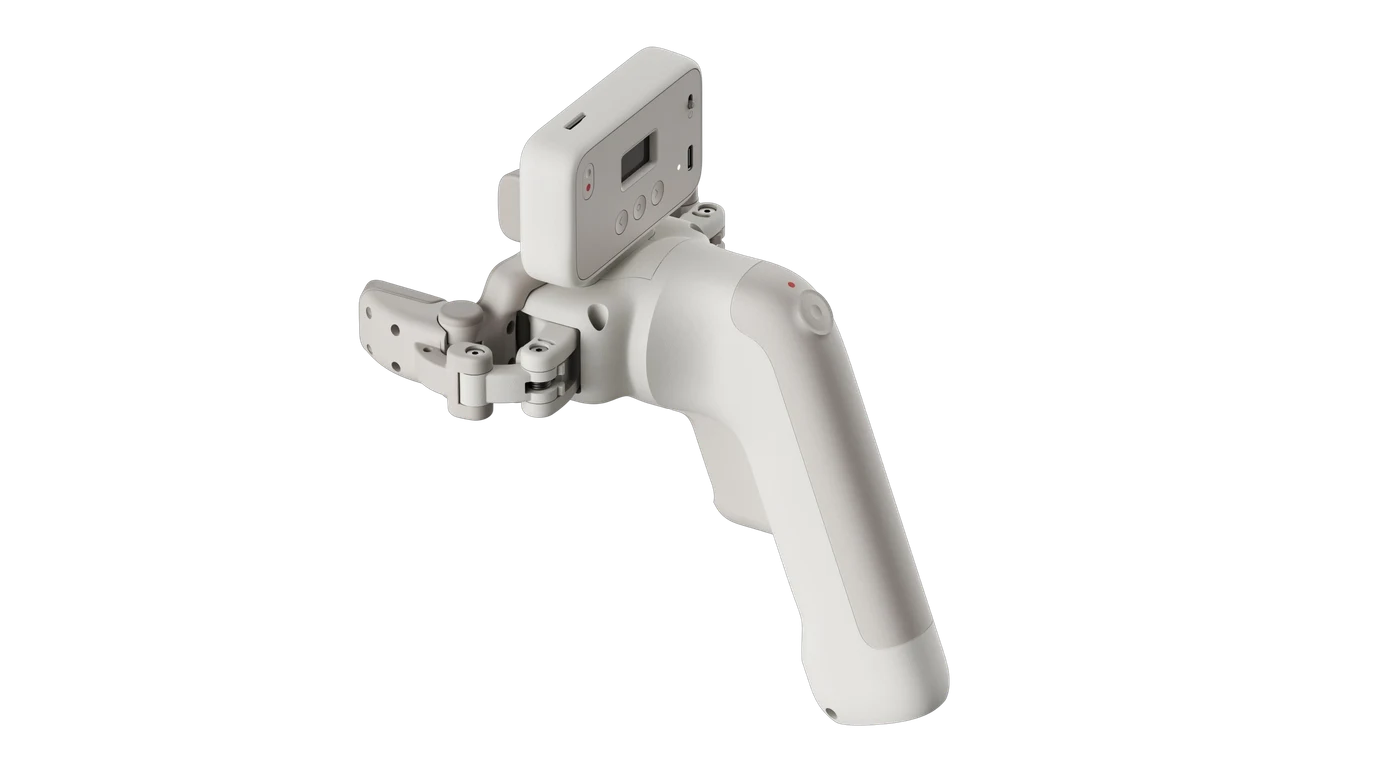
Explore gesture recognition, 3D hand pose and fingertip pressure prediction, paired with Ego, UMI, glove or real-robot data. Whether it improves task performance requires independent labels, cross-person and cross-day tests and controlled robot-task comparisons.
FMG + IMU / IN THREE DIMENSIONS
Wraps the forearm, linking motion and data.
Drag to view the ring exterior, inner contact surface and control area. Graphite black and champagne gold are material options; the display model is an independently simplified reconstruction.
One product, three ways to see it.
3D MODEL FMG + IMU
Drag to rotate · Scroll / pinch to zoom · Arrow keys
SEE THE SIGNALS
One manipulation, three ways to observe it.
From wearing position to what the data means: how FMG, IMU and the first-person view complement each other.
HUMAN / SENSOR / CONTEXT
01 / CONTACT
Capture motion cues at the forearm.
Records contact changes related to forearm muscle deformation. The signal varies with placement, tightness and the individual, so wearing baselines and calibration data are kept.
SIGNAL TRACE
What it records
Raw FMG output + wearing records
This is not EMG, nor ground-truth contact force between fingertips and objects.
FMG / SEE THE SYSTEM
Wear motion cues on the forearm.
One wearable setup, two demos: visual observation and forearm signals in the same study.
00:15 · silent version
01 / IN MOTION
Head-mounted stereo × two armbands, captured together.
Shows the head-mounted stereo camera with FMG armbands on both forearms, plus the 10×4 sensing array, IMU and 120 Hz stated in the video.
Shows the modular ring structure, inner contact units and the two-arm wearing setup. Hand pose and fingertip pressure in the video are model-prediction targets, not direct measurements.
Record signals; don't mistake them for ground truth.
Raw capture, model estimates and robot control are managed separately, preserving data provenance and validation boundaries.
01 / RECORD
Raw signals
Channel outputs of the FMG sensing units, IMU, device timestamps, wearing baseline and quality flags. Range, units and channel mapping are confirmed per hardware version.
Captured data02 / ESTIMATE
Model estimates
Explore gesture, 3D hand pose and fingertip pressure prediction, keeping model version, confidence and reference labels. Predictions are not treated as direct ground-truth measurements.
Research direction · to be validated03 / EVALUATE
Robot tasks
Paired with vision, tactile or real-robot records to evaluate whether manipulation improves. Mapping human signals to robot actions still requires mapping, constraints and real-robot safety checks.
Task evaluation
EGO + FMG + IMU
Hands stay free for natural contact; data keeps its multimodal context.
A head-mounted stereo camera records the viewpoint, and left and right armbands record signals from each side. Each session saves device IDs, side, placement and cross-device time mapping. Whether to add gloves, tactile end effectors or independent force sensors depends on the reference ground truth the task needs.
THE DETAILS MATTER
Every detail, spelled out.
Forearm FMG array and IMU capture, pairable with Ego head-mounted vision.
Product and sensing architecture
Parameter
Spec / configuration
Signal combination
FMG + IMU; no EMG channels
Form factor
Modular forearm capture armband; the video shows the ring structure and inner contact units
Sensing array
10×4 3D force-sensing array
Rate
120 Hz annotated in the video; sampling, transmission refresh and algorithm output should be defined separately, with rates stated per the confirmed hardware and interface version, and distinct from the IMU sampling rate
IMU
Inertial sensing and spatial orientation
Configuration
Head-mounted stereo + FMG armbands on both forearms
Communication
Wireless connectivity and local recording
EMG
The current confirmed configuration is FMG + IMU; no EMG sensor is claimed
The "high-precision / high-sensitivity" claims in the video give no range, accuracy or calibration conditions, so this page does not turn them into quantified performance commitments. 10×4 is not taken to mean 40 or 120 data channels.
Data and algorithm boundaries
Parameter
Spec / configuration
Raw data plan
Raw output of each FMG unit, inertial signals, device timestamps, sequence numbers and quality flags; actual fields subject to interface confirmation
Derived outputs
Model predictions such as gestures, 3D hand pose and fingertip pressure; output dimensions, model version, rate and accuracy to be validated
Reference ground truth
Hand-pose references, independent force / tactile measurements and human annotation paired per task; reference sensors selected separately
Cross-device sync
Clock mapping and sync events saved with Ego / UMI / real-robot data; Thor's in-device sync figures are not reused
Wearing records
Anonymous participant ID, left/right side, placement, orientation, tightness, resting baseline, date and re-wearing events
Data export plan
Raw data, calibration and derived results saved per session / episode; protocol, SDK license and platform adaptation to be confirmed
FMG is not EMG; forearm signals are not ground-truth fingertip contact force, and model predictions are not robot actions that can be executed without mapping.
Items to confirm per project
Parameter
Spec / configuration
Sensing performance
Range, sensitivity, accuracy, drift, hysteresis, overload capacity and temperature effects
Total weight, battery capacity, battery life, charging method, protection rating and cleaning
Link performance
End-to-end latency, packet loss, wireless coexistence, reconnection and multi-device concurrency
Software and algorithms
Supported systems, raw data access, SDK documentation, model licenses and cross-person calibration requirements
Acceptance scope
Fixed tasks, independent test users, cross-day re-wearing, baseline comparisons and safety boundaries
FROM CAPTURE TO ARCHIVE
From power-on to a complete data episode.
01
Put on and set a baseline
Confirm side, module orientation and tightness; complete resting, reference-motion and signal-quality checks as the version requires.
02
Sync the task and multimodal recording
Record task ID, video, FMG, IMU and sync events, keeping original timestamps and never conflating refresh rates of different devices.
03
Paired labels and model estimates
Generate supervision from reference poses or independent force measurements, recording model version and uncertainty; raw, reference and predicted data are stored separately.
04
Independent testing and failure feedback
Compare vision + IMU with and without FMG, splitting train and test sets by user, date and re-wearing, before deciding whether to move on to robot task validation.
CONFIGURE. VERIFY. DELIVER.
From selection to delivery, make the configuration clear.